Mike (@cinco_bajeena), a lapsed anime blogger, has the same origin story as plenty of other fans of a certain geography and age: a cloudy mix of Vampire Hunter D, Ghost in the Shell, Akira, and Macross Plus. You can occasionally find the telltale byline otou-san at Altair & Vega and Sea Slugs until his own blog returns from the deep again, as it probably will someday.
One of the calling cards of the aging anime fan, a relatively new species in the West, is his insistence that they just don't make 'em like they used to. And in the 21st century, a case could definitely be made for that. While the OVAs of the late 80s and early 90s heralded an anything-goes era of experimentation where the spectacular outweighed the sensical, anime in the post-industry-collapse world is increasingly marked by formula and safety: works that guarantee a hardcore otaku audience yet alienate other potential consumers.
But we've heard all that before. Years as recent as 2010 give us plenty of reason to believe this is the case — there's always hope.
Alexandra Roedder is finishing her Ph.D. in musicology at the University of California, Los Angeles, writing about Joe Hisaishi's Ghibli soundtracks. She first encountered anime on her TV in the form of Sailor Moon, but didn't recognize it as anime until years later when a friend who was really into anime had her watch Spirited Away, Grave of the Fireflies, and then the first few episodes of Ergo Proxy, all in one night. Since then, she's never turned back. When she's done with her degree she plans to write a few books about anime music aimed at closing the gap between academics and fans. She also plays cello professionally. You can find her personal blog (blog.alexandra-roedder.net) and her Twitter account at on @alexandramuses.
2001 was a year mostly notable for its anime films: Spirited Away is probably best known, but there was also Studio 4ºC's Princess Arete, the gekijouban presentation of Cowboy Bebop: Knockin' on Heaven's Door, and the epic Metropolis based on Tezuka's manga. However, television also had its gems from the year, surprisingly enduring shows on surprising subjects, each of which showed sensitivity and depth and tried to turn away from many of the stereotypes which 1990s anime had developed. Below I will discuss three shows I feel to be representative of the year: Mahoromatic, Hikaru no Go, and Angelic Layer.
Patrick Stoeckel began his anime life with the Toonami line-up, then moved on to the unedited DVDs. After that, it's been a steady stream of writing about it (via The Anime Discussion Corner before moving the blog to Anime Commentary) and occasionally teaching an informal class on the subject. His passion for anime runs deep, and his blog is his outlet for commentary. You can also find his commentary on Twitter at, appropriately, @AnimeCommentary.
I chose the year 2000 primarily because it lay within my early years of anime-watching (and, to be honest, it was one of the few remaining years available that I had any real knowledge of). My first real exposure to anime came through the significantly edited broadcasts of shows like Sailor Moon that made the rounds on Cartoon Network back in the day. That first experience got me hooked, and I began purchasing DVDs when I could. The unedited DVD releases of these shows informed me of how diverse Japan's animated fare could be, and I remained a fan ever since.
2000 was an interesting year for anime. Toonami still broadcast edited versions of shows that remained popular; the debut of [adult swim] the following year will change the broadcast dynamic for Cartoon Network. With Toonami, it would broadcast old favorites (such as Rurouni Kenshin and G Gundam) throughout the upcoming decade. As should be noted, Pokemon's popularity in the 1990s saw the emergence of the controversial 4Kids releases–controversial because of the "Americanization" and censoring elements prevalent in their broadcasts.
The dawn of the 21st century (and the new millennium) marked a surge of popularity in the Dragon Ball franchise, as well as other titles such as the various Gundam shows and Pokemon (all of which remain major pulls). The U.S. market proved very receptive to anime, ever since the previous decade, and the upcoming decade would see more shows being released (particularly on the Adult Swim block). As far as television in general goes, a few live-action dramas debuted (including Ikebukuro West Gate Park, which received a manga adaptation), and TV viewing had been astounding from the 1980s onward. But what did the anime scene look like in that year?
Well, that's what we're going to examine with this article. Sit back and enjoy; 2000 had some great releases, and this article looks at three.
In middle school, Naru appreciated anime, fanfiction, and pretty guys just as much as the next internet-surfing pre-teen, but it was actually in her high school years when she began to discover what was so "special" regarding the former. On a whim, she created her main blog Oromywhat where you can occasionally find her explaining or rambling endlessly about the Japanese pop culture and its secrets unknown to outsiders. If she ever disappears from her blog, you'll easily find her at Organization Anti-Social Genuises as an anime/manga reviewer or ranting on Twitter.
Before we begin focusing on the quiet year of 1999, I believe I should be honest with you all and straight out say 1999 was a year I personally did not know much about until I made the decision to participate in this project. Between the end of the 90's and the beginning of the 2000's, my little self was rather occupied with shonen anime being aired in my country at the time–Yu Yu Hakusho, Gundam, and the like–which aided and formed me into the grumpy hard-to-please anime appreciator that I am today.
However, it is until just recently that I've taken the time to search around the deepest parts of the dark hole that is the Internet to find out that, while 1999 isn't the most memorable year for some of us, it certainly wasn't an uneventful year. Heck, the year 1999 gave birth to cult anime adaptations that are still present in the minds of old fans, and now to new fans of the current generation.
Kadian1364 grew up with anime since middle school during the Pokemon and Toonami boom in the late 90's, and developed a voracious appetite for Chinese girl cartoons that hasn’t stopped since. Sometimes anime reviewer at the Nihon Review, sometimes content to make his opinion known on other blogs, he spews most of his on the Internet’s soapbox, Twitter (https://twitter.com/kenyaboi1364). He also relishes running weekend Skype calls with friends viewing the best and worst of anime’s history.
The mid-90's was a time of affirming stylistic and philosophical changes in the anime industry. The recognizable stereotype of popular anime characters folks still associate with the medium–realistic body proportions with large, expressive eyes and youthful facial features–largely developed and matured in these years. It was a hybrid of the cartoonish Disney-like designs Tezuka popularized and the realistically shaped heroes of the gritty science fiction and OVA anime that populated the 80's. It wasn't until a decade later would we see the dawn of a new character design paradigm. At the same time, disruptive titles in recent history like Saint Seiya, Sailor Moon, and Neon Genesis Evangelion made artists and producers think differently about who could be their prospective audience and how to design new works to reach them. Cross-gender pleasing characters were of course a major part of this emerging design philosophy, but the novel combinations of diverse genres was an emerging effort to broaden the demographic appeal of traditionally niche, gender-exclusive brands.
But before we get to the meat of this article, there are the also-rans worth enumerating. Of course, the second half of Evanglion in early '96, with its psychological complexity, artistic abstraction, and culturally relevant topics, so precisely struck a nerve with an entire generation of viewers that clones and variations would be seen for years to come. Slayers Next, the second of a series of seemingly arbitrarily titled seasons, continued the distinctly 90's-flavored high-fantasy gag-comedy action-adventure franchise. Kosuke Fujishima's You're Under Arrest found a home on TV after its '95 OVA, but instead of fluid car-chase animation, it found pleasant success in low-budget traffic police sitcom fare, spawning three seasons in total through the 90's and 2000's.
Gundam continued to roll out sequels and spinoffs, with After War Gundam X, an alternate universe TV series in a post-apocalyptic scenario with maximum colony dropping absurdity, and the 08th MS Team, an OVA returning to the "One Year War" from the perspective of grunts embroiled in the jungles of Southeast Asia, which earned points with fans for its gritty Vietnam-like take in the favored continuity. And the big traditional shoujo series from the year, Kodomo no Omocha (a.k.a. Kodocha), was the most off-the-wall, dizzyingly hyperactive melodramatic romantic comedy about child actors you'll probably ever see. (And this is just the opening theme! - Ed.)
While numerous titles deserve their due, a few series are so distinguished for finding trend-setting, audience-broadening combinations of diverse genre elements and their enduring popularity that they justify greater elaboration of critical merit.
Brian (@awesome_engine) used to have to write hundreds of movie synopses for the UK video market, which has left his brain full of unnecessary information. He is the co-host of the Dynamite In The Brain podcast and owner of AWESOME ENGINE. If you must see him in the flesh you can usually find him at UK anime conventions like Ayacon, hosting events such as MADstravaganza (now in its seventh year).
Not every year gave the viewer a brand new anime TV series that achieved greatness, longevity, or popularity. 1994 was one of those years.
The big shows of 1994 were all shows that started years previously. There are series that are still ongoing today like Sazae-san (1969), Doraemon (starting in 1973, but airing since 2005) and Crayon Shin-Chan (1992). In addition, there were the monster Shonen Jump shows of the day: Dragonball Z, Slam Dunk, and Yu Yu Hakusho. They all managed to get over a 20% audience share at various points in the year (with Dragonball Z doing it week in, week out). Finally, there were a couple of shows that have had little following in anglophone fandom, Kiteretsu Daihyakka (1988-96) and Tsuyoshi Shikkari Shinasai (1992-94). These aired either side of Sazae-san and regularly got at least a 20% audience share. One reason why it may have been difficult for new shows to get a footing was that 1994 was the year that some of these established shows hit their peak ratings; Dragonball Z, Kiteretsu Daihyakka, Tsuyoshi Shikkari Shinasai, Slam Dunk, and Yu Yu Hakusho all had their highest rated episodes during this year.
So what new shows were trying to get their voice heard this year?
In the late 1990s, Brian Ruh became seduced by the dark side of anime–the academic side. After reading the chapter “Vampires, Psychic Girls, Flying Women and Sailor Scouts” by Susan J. Napier, Brian decided that he wanted to become an anime scholar too. After all, what else was he going to do with a philosophy degree? He went on to get an M.A. in Asian Cultures and Languages from the University of Texas at Austin and then a Ph.D. in Communication and Culture from Indiana University. Along the way, he's written articles, book chapters, reviews, and a column for ANN. He also wrote the book Stray Dog of Anime: The Films of Mamoru Oshii, and is currently at work on a second edition to be released in 2014. He can be found on Twitter at @animeresearch, where he opines about anime and tells terrible puns.
Until I began investigating all of the shows that came out in 1992, I didn't really have any idea of the embarrassment of riches this year provided. I had originally decided to write about 1992 because it was around this time that I began re-discovering anime. I was born a couple of months after Star Wars first came out in the theaters–this created a wave of SF entertainment, particularly cartoons, throughout my formative years. My afternoons were filled with watching the likes of Battle of the Planets, Voltron, Starblazers, Robotech, and Tranzor Z, although I didn't know it as anime at the time. In late elementary and junior high school, I grew more towards Star Trek and the like, but early in high school I found myself back in the anime groove, thanks to a friend with a couple tapes of Robotech and Gunbuster.
Although I had my own subjective experiences of anime in 1992, at first I wasn't sure how to get a handle on what the year looked like for the Japanese industry. I figured that if I wanted to hit some of the highlights, it couldn't hurt to check out the covers of the major Japanese anime magazines–Newtype and Animage. Of course, I knew this wouldn’t be the whole story, but it would point us in the right direction of what was popular (or at least what the magazine editorial teams thought would sell) that year.
Thomas Zoth (ABCBTom) has only been reviewing anime for a year, but he's been a self-identified anime fan since 1997. The picture gets more complicated if you factor in Nick Jr. shows like The Noozles and Belle and Sebastian from when he was a kid. He writes frequently on Twitter, somewhat frequently for Fandompost.com, and when he feels like it at his blog, hungrybugdiner.com. He also wrote a journal article on the politics of One Piece in the Forum for World Literature Studies.
The highest grossing Japanese movie of 1991 is Isao Takahata's Only Yesterday (Omoide Poro Poro, or more literally "Memories With Tears."), and it serves as a good summation of the year itself. Many know Only Yesterday to be one of Ghibli's best, yet it is one of the only remaining Ghibli titles not to have any American release from Disney. It's a quiet, subtle film that would not be able to attract the large audiences Miyazaki's more family friendly, and less culturally specific works.
Only Yesterday isn't alone: 1991 is full of acclaimed, yet woefully overlooked classics.
Only Yesterday is fitting in another way. The story revolves around a woman named Taeko, who is tempted to leave the corporate rat race in 1980s Japan and run off to the idyllic furusato, or hometown, where she can live in peace off of nature's bounty. It's easy to see why it would resonate with a Japanese audience in 1991, as who wouldn't want to get away? 1991 was the final year of the Japanese economic bubble, and the nation went from economic excess and overvalued assets to a period of economic malaise that has arguably never fully lifted. After the bursting of the bubble, there would never be another Wings on Honneamise, released in 1987 with a huge 800 million yen budget, or another Akira.
The cyberpunk opus of 1991 was instead Roujin Z, written by Akira's Otomo, but directed by Hiroyuki Kitakubo. Unlike the brutal phantasmagoria of Akira, Roujin Z was a social satire about the care of the elderly. Roger Ebert gave the film three stars, and spoke of the potential of anime by saying "I cannot imagine this story being told in a conventional movie. Not only would the machine be impossibly expensive and complex to create with special effects, but the social criticism would be immediately blue-penciled by Hollywood executives." The title is currently unlicensed in America.
(Vincenzo Averello has been an anime fan for as long as he can remember but would probably say that Toonami's run of Outlaw Star is what cemented him as an anime fan. Recently he has been writing and podcasts for his site All Geeks Considered. You can occasionally see him doing panels at conventions in the north eastern United States. You can also see what's on his mind through his Twitter account, @VinnieAveAGC.)
I don't want to start with saying that 1990 was a year of transition for TV anime. Yes, this was a time of shift from 1980s to 1990s, but that is only because of when the year was placed. In all honesty, TV anime was pretty stagnant at that time, and very little stands out as truly great. Where greatness lied at this time was in the OVA market, which in seven years since 1983 had grown and flourished massively. This was the year when cult hits like Mad Bull 34, Cyber City Oedo 808, and Record of the Lodoss War began. With such releases as Guardian of Darkness, Devil Hunter Yohko, The Hakkenden, Patlabor: The New Files, and Sol Bianca, this year had 42 different OVAs hit the market. However, this article is about the TV shows of 1990, not the OVAs.
TV anime has always been known for its long-running shows, and this time period is no exception, as shows like Dragon Ball Z, Yawara: The Fashionable Judo Girl, Ranma 1/2, and City Hunter 3 had premiered the previous year and ran into (and often through) 1990. Even with these pillars of anime covered in other articles and getting ignored here, there is still a nice list of things that make 1990 a year with at least a few good and memorable shows.
Evan Jones is a writer and a communications analyst working in Hollywood. He regularly attends and speaks at anime events in the LA area, and he wrote this article while sitting next to framed cells from Patlabor and City Hunter. Find him on Twitter via @CrusherJones (for anime content) or via @EvanRJones (for non-anime content).
"1989! The number...another summer..." - Public Enemy
Retrospective pieces are a real challenge.
There's a lot of pressure about what to include, what to exclude, what to emphasize, and what to just blithely mention in a parenthetical. There's also a big threat of retroactive awareness coloring things in an odd light, especially after 20 plus years of time passing between back then(tm) and now(tm). It's a whole new game these days: our viewing habits, purchasing options, and information exchange processes have undergone a drastic evolution and are now light years ahead of the "good luck!" approach that characterized old-school fandom.
("Up-to-date streaming anime? Forgetta-bout-it. Back in those days we had import laser-disks, Xeroxed scripts, and comics printed on third-rate papyrus. 80 miles to school barefoot in the snow with nothing to eat but old stacks of Shonen Jump!")
But the long and short of it is simple; 1989 was a great year for televised anime. It was an adventurous and ambitious year that held something of interest for everybody regardless of taste. It was also a heady time where Gods of Manga, Super Saiyans, mechanized war machines, conflicted judoka, and gigantic belligerent pandas all vied for our eyeballs, our pocket money, and our hearts.
Thaliarchus is a recovered anime blogger (URL withheld to protect the guilty) who digs giant robots. In a tragic error of judgement his government has agreed to pay for his existence while he tries to write a Ph.D. thesis. He isn't researching anime, so unlike some other postgrads who've appeared here he has no professional interest in being identified by name--quite the opposite, in fact. However, he can be found on Twitter.
1988! A vintage year when My Neighbour Totoro, Char's Counterattack, Grave of the Fireflies, something called Akira--you may have heard of it--and a clutch of classic OVAs came out. The chances are that if you're interested enough to be reading these posts, you don't need me to tell you about 1988. Colony Drop even did a whole bunch of posts devoted to the year's highlights--go read them.
And that's one of the reasons I asked for this year, really: I know I'm really not as qualified to talk about this stuff as some other names who've appeared here, so I needed a year I could safely mess up. My plan is to talk briefly about the general picture of anime on television in 1988, then I'll offer the specific for the general and discuss one show in particular. I'll follow by turning my attention to 1988's rash of OVAs and finish with a few remarks about what we remember. I'm an arts student, and in a time of Big Data I work with small data, so while this could be a list of titles--and in parts it is--I thought I'd try not being synoptic.
Patrick is a long time anime fan that loves robots and crazy action. He has written for a bunch of blogs in the past and currently he can be found blogging about his love for mecha over on www.the-cockpit.net and still occasionally shows up guest blogging other places. Whenever he isn't blogging though you can find him on twitter (@PatzPrime) where he will no doubt be going on about anime, video games, and pro wrestling.
As we have already seen so far, the '80s were a very interesting time for anime. A whole new frontier began to grow as animators were given a chance to work on titles not just for television, but for direct video sales as well. This new market led to many new and unique titles that really stood the test of time. While this was happening, some of the biggest franchises in anime history were introduced to television viewers for the first time.
Really that is what drew me to 1986, a year that had quite a contrast. On television growing franchises like Gundam were continuing to gain a foothold while new kings of the industry like Dragon Ball had their television debut. Meanwhile on home video, shows like MD Geist just didn't seem to care what expectations were and just wanted to have fun. Interestingly enough, these titles that were so significant in Japan also ended up being very important internationally.
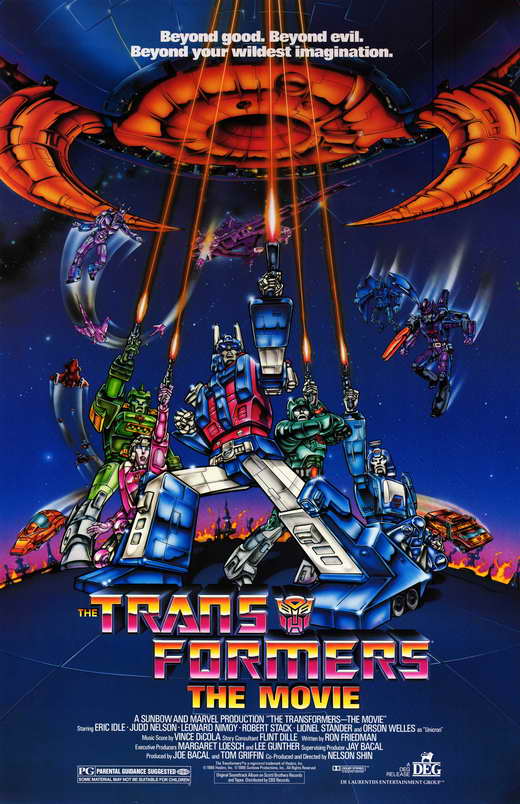
It was also the year that Transformers: The Movie hit theaters.
Transformers is a strange franchise as it is managed by two separate companies, Hasbro and Takara. For some reason, the decision was made not to release the film domestically in Japan in 1986. This is an interesting twist for the franchise, mainly because 1986 was when the continuity split between the US and Japanese cartoons got started. Comics were released to cover the hole between the two, but following the third season of the show, new seasons were produced in Japan that completely split the stories up. Honestly it is one of my personal favorite movies, so I would be remiss to not bring it up before diving into what made 1986 really special for anime.


 Alexandra Roedder is finishing her Ph.D. in musicology at the University of California, Los Angeles, writing about Joe Hisaishi's Ghibli soundtracks. She first encountered anime on her TV in the form of Sailor Moon, but didn't recognize it as anime until years later when a friend who was really into anime had her watch Spirited Away, Grave of the Fireflies, and then the first few episodes of Ergo Proxy, all in one night. Since then, she's never turned back. When she's done with her degree she plans to write a few books about anime music aimed at closing the gap between academics and fans. She also plays cello professionally. You can find her personal blog (blog.alexandra-roedder.net) and her Twitter account at on @alexandramuses.
.bmp)

.bmp)

.bmp)

.bmp)


.bmp)
 Only Yesterday isn't alone: 1991 is full of acclaimed, yet woefully overlooked classics.

.bmp)


.bmp)
 As we have already seen so far, the '80s were a very interesting time for anime. A whole new frontier began to grow as animators were given a chance to work on titles not just for television, but for direct video sales as well. This new market led to many new and unique titles that really stood the test of time. While this was happening, some of the biggest franchises in anime history were introduced to television viewers for the first time.